A public safety awareness campaign making street crossings safer for blind and low vision pedestrians.
THE MAIN MESSAGE
Street crossing safety is a shared responsibility. People who are blind or have low vision travel independently using white canes, guide dogs, specialized travel skills, and information from their surroundings. Drivers and cyclists share responsibility through their actions on the road.
WHAT IS EVERY CROSSING COUNTS?
- Every Crossing Counts is a public safety awareness campaign developed by Pine Tree Guide Dog Users with contributions from organization members, guide dog schools, blindness professionals, and community partners.
- The campaign teaches drivers and cyclists how to recognize pedestrians using white canes and guide dogs and how to respond safely.
- Recognizing a white cane or guide dog is an important first step, but recognition alone is not enough. Knowing how to respond matters, too.
WHAT SHOULD DRIVERS
AND CYCLISTS DO?
1. Stay Alert
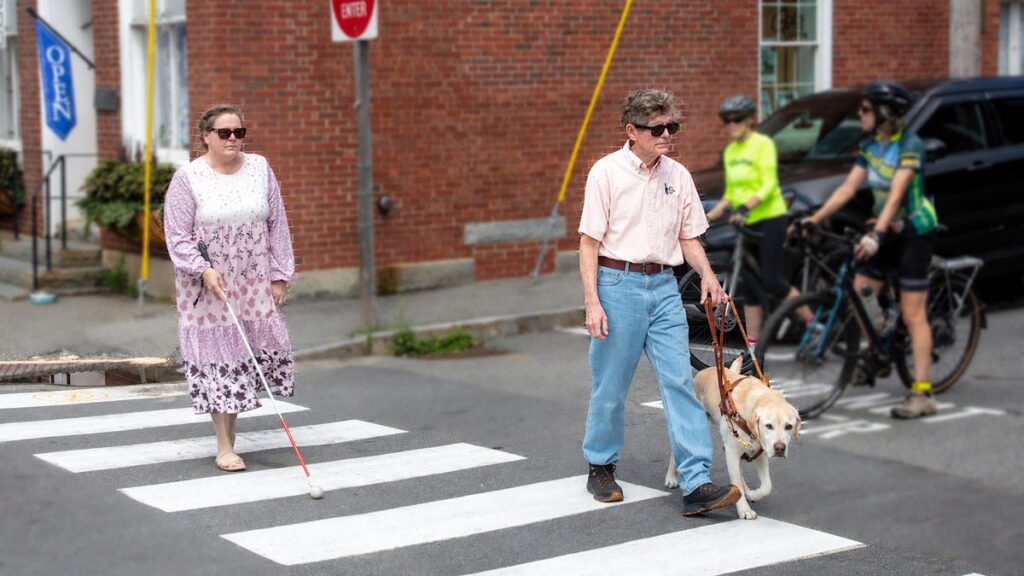
- Watch for pedestrians using long white canes or guide dogs wearing specialized harnesses with rigid handles.
- A white cane or guide dog signals that the pedestrian is blind or has low vision.
2. Slow Down
- Use extra caution when approaching a pedestrian using a white cane or guide dog.
- Slowing down provides more time to assess the situation and respond safely.
3. Yield
- Give the right of way.
- Allow the pedestrian sufficient time and space to make a safe crossing.
WHY ARE PREDICTABLE ACTIONS IMPORTANT?
- Pedestrians who are blind or have low vision often use traffic sounds and vehicle movement to understand how traffic is moving and decide when to cross.
- Following traffic laws, including applicable white cane laws, allows pedestrians to better anticipate what drivers and cyclists will do.
- Coming to a complete stop when yielding makes the vehicle’s movement easier to interpret than slowing or rolling forward. Keeping the crossing clear also provides the pedestrian with an unobstructed path.
WHY ARE COMMON COMMUNICATION SIGNALS UNRELIABLE?
- Eye contact, hand gestures, and head nods depend on visual information that a pedestrian who is blind or has low vision may not see.
- Pedestrians can only guess whether a horn, bicycle bell, or shouted instruction is meant for them or another road user. Even when the sound is directed at them, it does not reliably convey what action they are expected to take or whether traffic in other lanes or approaching from other directions has stopped.
- These sounds can also make pedestrians feel pressured to cross before they are ready, startle them, or drown out important auditory cues.
WHAT OTHER CONDITIONS CAN AFFECT A CROSSING?
- Much of the visual information used for crossing streets—such as pedestrian signals, turn signals, and the ability to watch traffic—is often unavailable to pedestrians who are blind or have low vision.
- Electric, hybrid, and auto start-stop equipped vehicles can be more difficult to detect by sound.
- Roadway features and traffic conditions—including multiple lanes, turning traffic, roundabouts, floating bus stops, higher speeds, and complex signal patterns—can make crossings more difficult to assess.
WHAT SHOULD PEOPLE UNDERSTAND ABOUT WHITE CANES
AND GUIDE DOGS?
- A long white cane, with or without a red tip, is an internationally recognized symbol of blindness and low vision.
- Unlike a pet dog being walked on a leash, a working guide dog wears a specialized harness with a long, rigid handle that the pedestrian uses for guidance.
- White canes and guide dogs are mobility aids that support safe, independent travel.
- In most states, white cane laws provide heightened protections for pedestrians using white canes or guide dogs.
A SIMPLE WAY TO EXPLAIN
THE CAMPAIGN
“People who are blind or have low vision cross streets independently using white canes and guide dogs. Every Crossing Counts reminds drivers and cyclists that street crossing safety is a shared responsibility: Stay Alert. Slow Down. Yield.”
LEARN MORE AND SHARE
THE CAMPAIGN
Free flyers, brochures, campaign information, and other materials are available at: